+86 21 61767181
info@highspeeddoor.cn
 English
 Español
 Русский

In modern industrial facilities, the rigid spiral door represents the pinnacle of premium access control. These doors are tasked with lifting heavy, insulated aluminum slats seamlessly while maintaining blistering velocities. However, a door panel is only as capable as the powerhouse that drives it.
Operating under continuous high-frequency demands, a spiral door drive system must deliver exceptional torque without sacrificing control. To help door manufacturers and system integrators understand what makes these systems so reliable, we break down the internal engineering—the true anatomy—of a premier spiral door motor designed to thrive under pressure.
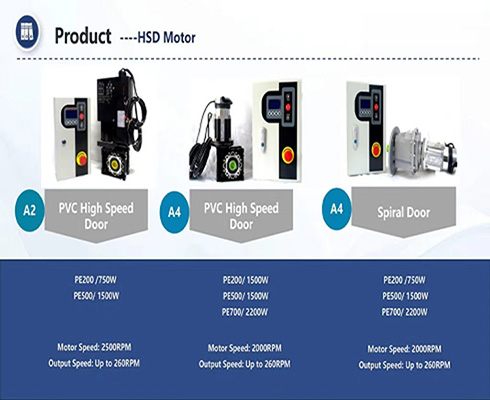
Traditional industrial doors have long relied on standard asynchronous induction motors. While durable, they rely on basic on/off logic that struggles with the heavy load profiles of rigid spiral slats.
*Dynamic Torque Control: Modern spiral door systems utilize permanent magnet synchronous servo motors. This core architecture delivers maximum torque right from a complete standstill, allowing the heavy aluminum curtain to accelerate upward instantly without straining the internal components.
*Thermal Efficiency: Because servo motors inherently draw power dynamically based on real-time load requirements, they generate significantly less internal heat. This eliminates the common issue of thermal shutdown during peak operating hours in busy logistics hubs.
Lifting a heavy rigid door at high speed requires subtle speed transitions to prevent mechanical self-destruction. The modern controller box acts as the precise brain of the entire drive system.
*S-Curve Motion Profiles: The smart drive software ensures the motor never experiences sudden kinetic jolts. It implements a smooth "S-Curve" acceleration profile—gradually ramping up velocity, maintaining a high-speed cruise, and smoothly decelerating before achieving a perfect seal.
*Intelligent Protection: Built-in intelligent algorithms constantly monitor grid voltage and mechanical resistance. If a minor obstruction occurs, the system instantly logs a soft fault code rather than letting the motor force its way through and damage the door framework.
When dealing with high velocity and heavy weight, a positioning error of even a few centimeters can cause catastrophic damage to both the door panels and the drive gear.
*Eliminating Limit Switches: High-speed spiral operations completely reject mechanical limit switches, which wear down and drift over time due to friction. Instead, they integrate high-resolution digital absolute encoders.
*Unmatched Repeatability: The absolute encoder tracks the millimeter-perfect position of the door curtain at all times. Even during a complete facility power outage, the encoder remembers the exact position of the door upon reboot, eliminating the need for tedious manual recalibration.
The table below provides an overview of how specialized engineering features directly influence the operational performance of high-speed rigid doors, focusing on functional value rather than dense numbers.
|
Engineering Component |
Standard Induction Drive |
High-Torque Spiral Servo Drive |
Operational Impact |
|
Motor Architecture |
Asynchronous Induction |
Permanent Magnet Synchronous |
Provides constant maximum torque with significantly lower heat generation. |
|
Positioning Accuracy |
Mechanical Limits Incremental |
Digital Absolute Encoder |
Guarantees a perfect perimeter seal and completely eliminates limit drift. |
|
Velocity Management |
Single or Dual Speed Jolt |
Intelligent "S-Curve" Ramping |
Protects internal gears and slats from mechanical shock during high-speed cycles. |
|
Diagnostic Feedback |
Basic relay signals |
Bilingual Smart Display Screen |
Allows maintenance teams to decipher fault codes in under five minutes. |
|
Mechanical Wear |
High (Due to sudden stops) |
Near-Zero (Smooth electronic braking) |
Drastically extends the operational lifespan of the entire hardware ecosystem. |
Power and intelligence mean nothing if they cannot be effectively transferred to the door shaft. The final critical element of the motor anatomy is the gear reduction system.
Specialized spiral door motors use precision-machined, oil-bathed helical gearboxes. This enclosed design completely seals out industrial dust, moisture, and debris while ensuring whisper-quiet operation. By eliminating exposed chains or external belts, the drive system maintains an airtight transmission efficiency that matches the high-speed demands of modern automation.
Upgrading to an engineered high-torque spiral door motor is a strategic choice for high-frequency facilities. By combining permanent magnet servo power, absolute encoder precision, and smart software control, these drive networks transform a simple physical gate into an asset of pure operational efficiency.
Company Name:Hitch (Shanghai) Automation Co.,Ltd.
Name: Lucky Gao
Mobile:15901664615
Tel:+86 21 61767181
Whatsapp:+8615901664615
Email:info@highspeeddoor.cn
Email:kevin.jiang@powever.com.cn
Add:Room 301-302, Building 1, No. 1355, Chengbei Road, Jiading District, Shanghai
Post code:201800