+86 21 61767181
info@highspeeddoor.cn
 English
 Español
 Русский

Selecting the correct power rating for a high-speed door motor or spiral door motor requires a precise balance of mechanical engineering factors. Under-sizing the motor leads to frequent overheating, thermal tripping, and a severely shortened lifespan. Conversely, over-sizing results in unnecessary capital expenditure, increased energy bills, and excessive torque shock to the door’s structural tracks and gearboxes.~
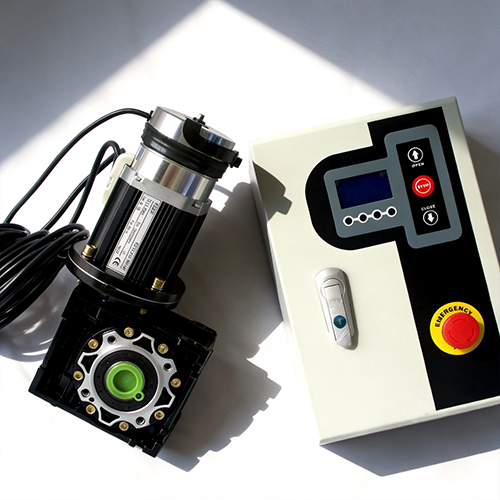
*A. Key Mechanical Factors Influencing Motor Power Sizing
To pinpoint the exact motor power required for a high-speed roll-up or spiral door, manufacturers evaluate four crucial physical dynamics:
*B. Total Curtain Weight and Material Mass
Material Density: The physical weight of the door panel dictates the baseline ineFabric vs. Rigid: High-speed flexible PVC doors are inherently lightweight, making them compatible with smaller motors. rtia that the motor must overcome.
Insulated Slats: On the other hand, rigid spiral high-speed doors feature double-walled insulated aluminum or steel slats. These heavy-duty components require substantially higher torque to initiate movement.
*C. Velocity and Acceleration Demands
Operating Speeds: High-speed doors operate at rapid velocities ranging from 0.8 m/s to over 2.5 m/s.
Thermal Exposure: Rapid opening speeds are essential to minimize the duration of environmental exposure in climate-controlled zones.
Torque Spikes: Because power is directly proportional to speed and force, accelerating a heavy aluminum curtain to high speeds within fractions of a second requires sharp spikes in motor power output.
*D. Wind Pressure and Environmental Friction
Pressure Differentials: Exterior high-speed doors are constantly subjected to wind loads or positive/negative pressure differentials between rooms.
Track Friction: When wind forces press against the door curtain, the panel slats are pushed hard against their side guide tracks, increasing mechanical friction exponentially.
Power Reserves: The motor must possess sufficient power reserves to reliably drive the door up or down under severe wind conditions without stalling.
*Final Technical Checklist for Global B2B Buyers
When procuring high-speed door motors or negotiating with OEM factories, ensure your procurement specifications explicitly address the following criteria:
Electrical Grid Compatibility: Verify input power constraints, such as 3-Phase 230V, 380V, 400V, or 460V at 50Hz/60Hz.
Duty Cycle Rating: High-speed industrial environments demand an S3 duty cycle rating (intermittent periodic duty) or higher to handle up to 60 to 100 cycles per hour.
Ingress Protection (IP Rating): Specify IP54 for clean indoor locations, IP65 for standard exterior use, and IP67/IP69K for hygienic food-processing washdown facilities.
*Conclusion
Choosing the right power for a high-speed door motor is not simply about picking the highest number available; it is a calculated decision based on weight, frequency, speed, and environmental demands. By aligning your door specs with the correct kW or HP rating and utilizing modern smart drive control systems, industrial facilities can secure seamless operations, lower energy overheads, and guarantee long-term performance reliability.
Company Name:Hitch (Shanghai) Automation Co.,Ltd.
Name: Lucky Gao
Mobile:15901664615
Tel:+86 21 61767181
Whatsapp:+8615901664615
Email:info@highspeeddoor.cn
Email:kevin.jiang@powever.com.cn
Add:Room 301-302, Building 1, No. 1355, Chengbei Road, Jiading District, Shanghai
Post code:201800