Roll-Up Doors vs Sectional Doors: Design, Motor Technology and Application Differences
Whether for retail storefront renovation or logistics operation optimization in large-scale warehouses, selecting a suitable door system is a key factor affecting daily operational efficiency. Roll-up doors and sectional doors are two mainstream options widely used in residential, commercial and industrial scenarios. Despite overlapping application scenarios, the two differ greatly in structural design, operating principles, space occupation and supporting motor systems. This article comprehensively compares their core characteristics and technical differences to support targeted selection for different usage environments.
1. Basic Structure and Application Characteristics of Two Door Types
1.1 Roll-Up Doors
Roll-up doors are designed with a focus on structural simplicity and minimal space occupancy, making them ideal for compact and obstacle-intensive installation environments.
Design & Engineering: The main body of a roll-up door is composed of multiple interlocking horizontal metal slats, mostly made of durable steel or aluminum alloy. Its most distinctive structural feature lies in the storage method after opening: the door slats rise vertically along the door opening and are tightly coiled on the drum shaft installed directly above the doorway, forming a compact cylindrical structure.
Operational Advantages: Since the door body is fully stored above the doorway after opening, no ceiling tracks are required, and no extra clearance space is occupied outside the door opening. This structural advantage enables roll-up doors to adapt perfectly to scenarios with limited headroom and complex top obstacles, maximizing the utilization rate of building space.
1.2 Sectional Doors
Sectional doors are a classic mainstream choice for large door openings and thermal insulation-required environments, balancing practicality, appearance and thermal performance.
Design & Engineering: A sectional door is assembled from multiple independent hinged panels, most of which are filled with thermal insulation materials, and some panels can be customized with transparent windows for lighting needs. When opening, the hinged panels slide upward along the fixed tracks on both sides of the doorway and finally lie flat on the ceiling.
Operational Advantages: Although sectional doors need to occupy certain ceiling space for track installation, they have obvious advantages in appearance and thermal insulation performance compared with conventional roll-up doors. Meanwhile, this door type supports customized production of super-large sizes and is widely applicable to industrial workshops, large warehouse bays and other scenarios with large opening sizes.
2. Core Differences in Supporting Motor Technology
The motor is the core power component that determines the door’s operating stability, service life and functional performance. Corresponding to the different structural characteristics and usage scenarios of the two doors, high-speed roll-up door motors and sectional door motors are designed with completely different technical orientations and performance parameters.
2.1 High-Speed Door Motors
Core Design Mission: This type of motor is developed for high-frequency access scenarios that require strict environmental control. It is mainly used in food processing workshops, cold storage, clean rooms and other places. By realizing rapid opening and closing of the door body, it effectively reduces indoor and outdoor air convection, avoids temperature loss, cuts energy consumption, and greatly improves the passing efficiency of high-traffic areas.
Core Motor Technology: High-speed roll-up door motors adopt direct-drive technology, with the motor body directly connected to the door’s drum shaft. This integrated structure eliminates external transmission accessories such as belts and chains, avoiding mechanical loss and failure risks of traditional transmission structures. It supports soft start and soft stop, realizes rapid and stable acceleration and deceleration, and is equipped with advanced electronic control systems, which can realize variable speed adjustment and real-time obstacle detection, with high operation accuracy and safety.
Durability Performance: The motor is designed with over-engineering standards, with strong structural robustness. It can adapt to ultra-high-frequency cyclic work and stably complete thousands of opening and closing cycles every year, meeting the long-term high-intensity operation needs of industrial scenarios.
2.2 Sectional Door Motors
Core Design Mission: Different from the high-speed operation orientation of roll-up door motors, sectional door motors are positioned on safe and stable lifting of heavy door panels. They focus on solving the lifting demand of large-weight hinged panels and are not suitable for ultra-high-frequency rapid cyclic operation.
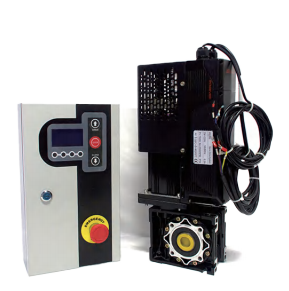
Core Motor Technology: Most sectional door motors adopt chain drive or belt drive structures. The motor drives the gear to operate, pulls the trolley on the ceiling track, and then drives the door panels to open and close. The whole system relies on high-torque output to complete the initial lifting of the heavy door body, and is matched with heavy-duty balance springs to reduce motor load and ensure stable operation.
Durability Performance: The motor has reliable basic durability and can meet daily conventional use needs of residential garages, commercial buildings and other scenarios. However, its structural design and power performance cannot bear the ultra-high-frequency and continuous cyclic working state of high-speed door systems, and the service life will be greatly reduced under high-intensity operation.
3. Parameter Comparison
|
Feature
|
High-Speed Roll-Up Motor
|
Sectional Door Motor
|
|
Operational Focus
|
High operating velocity, precise environmental control, high traffic efficiency
|
Stable lifting, high torque output, safe operation and security
|
|
Typical Speed
|
Rapid operation (up to multiple feet per second)
|
Stable and low-speed operation (standard conventional opening speed)
|
|
Drive System
|
Inline Direct-Drive
|
Chain Drive, Belt Drive or Jackshaft Drive
|
|
Operating Frequency
|
Extremely high (hundreds of cycles per day)
|
Low to moderate (tens of cycles per day)
|
|
System Complexity
|
Advanced configuration (equipped with VFD variable frequency technology and intelligent sensors)
|
Simple and practical (equipped with standard safety protection functions)
|
 English
 Español
 Русский