+86 21 61767181
info@highspeeddoor.cn
 English
 Español
 Русский

In an industrial environment, a high-speed door is more than just an entrance—it is a critical component of the logistics chain. However, frequent operation, harsh environments, and mechanical stress often lead to premature wear and costly downtime. For warehouse managers and factory owners, the "lifespan" of a door is directly linked to the ROI (Return on Investment).
The secret to doubling or even tripling the life of a high-speed door lies not in the fabric itself, but in the Intelligence of the Control System.
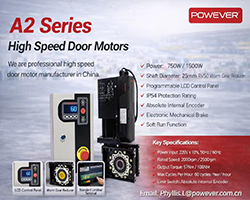
The primary cause of mechanical fatigue in industrial doors is the sudden impact during the start and end of a cycle. Traditional "Direct-on-Line" motors jerk the door into motion, causing stress on the slats, hinges, and motor gears.
Modern high-speed door controllers utilize Variable Frequency Drives (VFD) or Servo Drives to implement "S-Curve" acceleration and deceleration.
Soft Start: Gradually increases the torque, preventing the sudden "snapping" of the drive chain or belt.
Soft Stop: The door slows down before reaching the final limit, ensuring a whisper-quiet and impact-free closure.
Traditional doors use mechanical limit switches or incremental encoders to "guess" where the door is. Over time, these components slip or drift due to vibration and temperature changes, causing the door to crash into the header or the floor.
An Absolute Encoder assigns a unique digital code to every millimeter of the door’s travel.
No Position Loss: Even after a total power failure, the system knows exactly where the door is without needing to "reset" or "re-home."
Zero Drift: By eliminating physical contact switches, you remove the most common failure point in industrial door systems.
Most door failures happen because minor issues go unnoticed until they become catastrophic breakdowns. Advanced control systems transform reactive maintenance into Predictive Maintenance.
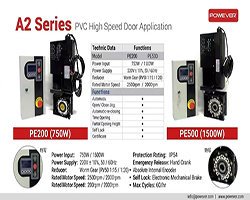
The latest generation of controllers features bilingual LCD screens (English/Chinese) that display.
Cycle Counters: Alerts the team when it is time for a scheduled lubrication or spring tension check.
Historical Fault Logs: Tracks previous errors (e.g., "Over-current" or "Sensor Obstruction") to help technicians identify patterns and root causes quickly.
The following table highlights how different components impact the long-term durability of the door.
|
Feature |
Standard Asynchronous System |
Advanced Servo Control System |
Impact on Lifespan |
|
Limit Positioning |
Mechanical Switches (Prone to wear) |
Absolute Encoder (Non-contact) |
High: Prevents accidental crashes. |
|
Motor Action |
On/Off (High impact) |
Soft Start/Stop (Low impact) |
Very High: Reduces mechanical stress by 60%. |
|
Heat Management |
High (Internal friction) |
Low (Efficient energy conversion) |
High: Prevents motor burn-out. |
|
Troubleshooting |
Manual Guesswork |
Digital Fault Codes (LCD) |
Moderate: Reduces repair time and errors. |
|
Energy Consumption |
High (Inrush current) |
Low (Optimized torque) |
Economic: Lower operational costs. |
No matter how good the motor is, a forklift collision will shorten the door's life instantly. Advanced control systems integrate seamlessly with high-end sensors:
Light Curtains (CEDES): Creates a dense safety grid that detects even the smallest object, preventing the door from closing on a load.
Motion Radars (BEA): Differentiates between cross-traffic and approaching vehicles to prevent unnecessary cycles, preserving the motor’s total cycle life.
Company Name:Hitch (Shanghai) Automation Co.,Ltd.
Name: Lucky Gao
Mobile:15901664615
Tel:+86 21 61767181
Whatsapp:+8615901664615
Email:info@highspeeddoor.cn
Email:kevin.jiang@powever.com.cn
Add:Room 301-302, Building 1, No. 1355, Chengbei Road, Jiading District, Shanghai
Post code:201800