+86 21 61767181
info@highspeeddoor.cn
 English
 Español
 Русский

In the rapidly evolving industrial door market, the performance of a high-speed door is largely dictated by its "heart"—the drive system. For manufacturers and distributors of PVC high-speed doors, the debate between Servo Motors and Asynchronous Motors is more relevant than ever.~~
While one offers cutting-edge precision, the other stands as a testament to cost-effective reliability. This article breaks down the technical differences and market applications to help you decide which system aligns with your business goals.~~
1. Servo Motors: The Precision Specialist**
Servo motor systems (often paired with high-performance encoders and controllers) represent the premium standard for modern high-speed doors.
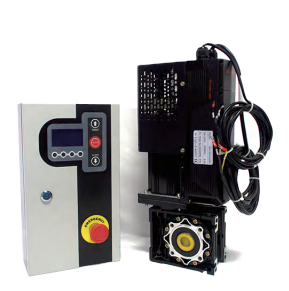
**Key Advantages:
Precision Control: Unlike standard motors, servo systems use closed-loop control. This ensures the door stops at the exact limit positions every time, preventing over-travel and mechanical wear.
Superior Speed Performance: Capable of rapid acceleration and deceleration. If your application requires speeds exceeding 1.5m/s - 2.0m/s, a servo motor is the undisputed choice.
Energy Efficiency: Servo motors only consume significant energy during movement and are highly efficient at variable speeds, reducing the overall carbon footprint of a facility.
Smart Features: Most servo controllers support "Soft Start & Soft Stop," built-in obstacle detection, and detailed error coding for easier troubleshooting.
**Best For:
High-end food processing plants, pharmaceutical cleanrooms, and high-frequency logistics hubs where precision and intelligence are non-negotiable.
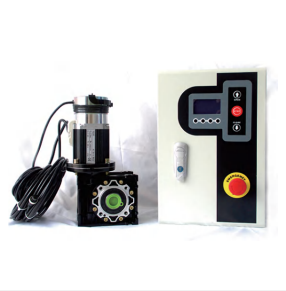
2. Asynchronous Motors: The Reliable Workhorse
Asynchronous (induction) motors, usually paired with an external frequency inverter (VFD), have been the industry standard for decades.
**Key Advantages:
Unbeatable Cost-Effectiveness: The initial investment for an asynchronous drive system is significantly lower than a servo system. This makes them highly competitive in price-sensitive markets.
Durability and Simplicity: Known for their robust construction. In environments with unstable power grids or extreme temperatures, the simpler electronics of an asynchronous system can sometimes be more resilient.
Ease of Maintenance: Because they are a global standard, finding replacement parts or local technicians who can service an asynchronous motor is generally easier and cheaper.
Adaptability: For doors that don't require extreme precision (e.g., standard warehouse partitions), an asynchronous motor with a good inverter provides more than enough performance.
**Best For:
Standard industrial warehouses, emerging markets, and applications where the budget is the primary driver and extreme speed is not a requirement.
3. Technical Comparison at a Glance
|
Feature |
Servo Motor System |
Asynchronous Motor |
|
Positioning Accuracy |
Extremely High |
Moderate |
|
Response Speed |
Instantaneous |
Slight Delay |
|
Heat Dissipation |
Low (High Efficiency) |
Moderate to High |
|
System Complexity |
High |
Low |
|
Initial Cost |
Premium |
Economical |
4. Market Strategic Advice: Which Should You Choose?
As a door manufacturer, your choice should be dictated by your target market positioning:
Targeting Premium/High-Tech Clients? Lead with Servo Systems. The "intelligent" branding, superior speed, and low maintenance appeal to corporate clients focused on ROI and safety.
Targeting Emerging Markets or Budget-Conscious Projects? Lead with Asynchronous Systems. These allow you to offer a reliable, functional high-speed door at a price point that "Traditional Roller Shutter" users find attractive for an initial upgrade.
Conclusion~~
There is no "one-size-fits-all" answer. The Servo Motor is a leap into the future of automation and precision, while the Asynchronous Motor remains a powerful tool for scaling business in cost-sensitive regions.~~
By offering both options, door manufacturers can capture the full spectrum of the market—from basic industrial upgrades to high-end automated facility requirements.~~
Company Name:Hitch (Shanghai) Automation Co.,Ltd.
Name: Lucky Gao
Mobile:15901664615
Tel:+86 21 61767181
Whatsapp:+8615901664615
Email:info@highspeeddoor.cn
Email:kevin.jiang@powever.com.cn
Add:Room 301-302, Building 1, No. 1355, Chengbei Road, Jiading District, Shanghai
Post code:201800