+86 21 61767181
info@highspeeddoor.cn
 English
 Español
 Русский

Whether securing a retail storefront or optimizing logistics in a massive warehouse, choosing the right door system is crucial for operational efficiency. The primary choice is between Roll-Up Doors and Sectional Doors. While they share similar applications in residential, commercial, and industrial settings, their design, operation, and space requirements differ significantly.
Part 1: Door Types and Applications
1. Roll-Up Doors
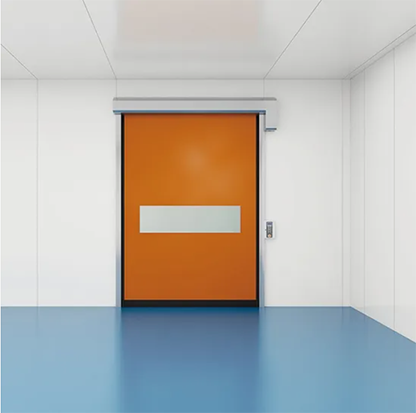
Roll-up doors are engineered for simplicity and minimal spatial impact.
Design & Engineering: These doors are constructed from dozens of interlocking horizontal metal slats (usually steel or aluminum). The core differentiator is how they store: when opened, the slats travel vertically and coil tightly around a drum or barrel located directly above the door opening.
Operational Advantage: Because the door rolls into a compact cylinder above the header, it requires zero ceiling tracks and zero clearance outside the opening. This makes them perfect for environments with limited headroom or obstructions.
2. Sectional Doors
Sectional doors are the traditional standard for larger openings and insulated environments.
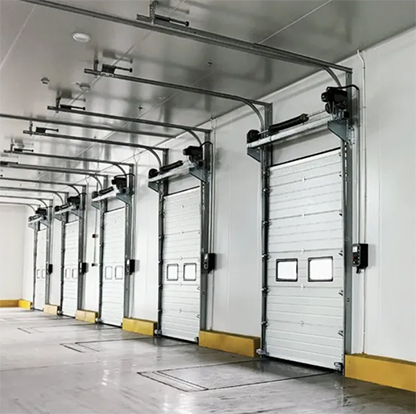
Design & Engineering: Sectional doors consist of large, hinged panels (often insulated, and sometimes featuring windows). These panels glide upward along tracks mounted on either side of the opening and come to rest flat against the ceiling.
Operational Advantage: While they require ceiling space for the tracks, they offer superior aesthetics and better thermal insulation compared to standard slat doors. They can be manufactured in massive sizes for industrial bays.
Part 2: The Difference in Motor Technology
A door’s reliability depends entirely on the motor that drives it. Just as the doors themselves differ, the motors—High-Speed Roll-Up Motors and Sectional Door Motors—are engineered for fundamentally different operational goals.
High-Speed Roll-Up Door Motors:
The Mission: To maintain strict environmental control (e.g., in food processing, cold storage, or cleanrooms), reduce energy loss, and maximize productivity in high-traffic zones. These doors can achieve speeds of several feet per second.
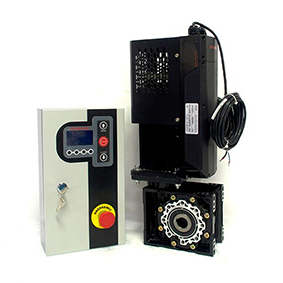
The Motor Tech: High-speed motors are typically Direct-Drive. This means the motor is directly connected to the door’s barrel shaft, eliminating external belts or chains. This creates a "soft start/soft stop" operation, rapid acceleration, and precise control. They often incorporate advanced electronics for variable speed control and instant obstacle detection.
Durability: These motors are robust and over-engineered to handle thousands of cycles (openings/closings) per year.
High-speed roll-up doors are designed for rapid opening and closing, often achieving speeds of several feet per second. These doors are typically used in environments where minimizing the time the door remains open is critical—such as in food processing facilities, cold storage, or cleanrooms. The high-speed operation helps maintain temperature control, reduce energy loss, and enhance productivity.
Sectional Door Motors:
Sectional doors consist of several horizontal panels hinged together, which move along tracks on both sides of the door opening as they open and close. These doors are common in residential garages and commercial buildings where space is at a premium, as they do not extend outward when opening.
The Mission: To safely and reliably lift the weight of the heavy hinged panels. They are not built for rapid-fire cycling.
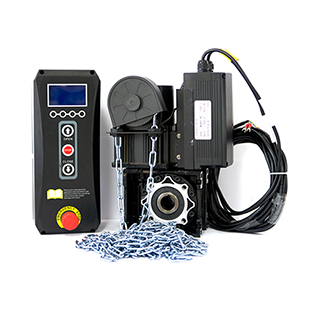
The Motor Tech: Sectional motors often use a Chain or Belt Drive system. The motor rotates a gear, which pulls a trolley along a ceiling-mounted rail, moving the panels. They focus on the high torque required for the initial lift and rely on heavy-duty counterbalancing springs.
Durability: While durable and capable of daily use, standard sectional motors are not designed for the extreme duty cycles and relentless frequency of a high-speed system.
|
Feature |
High-Speed Roll-Up Motor |
Sectional Door Motor |
|
Operational Focus |
Maximum velocity and environmental control |
Controlled lifting, torque, and security |
|
Typical Speed |
Rapid (up to multiple feet per second) |
Deliberate (standard opening speed) |
|
Drive System |
Direct-Drive (Inline) |
Chain, Belt, or Jackshaft Drive |
|
Frequency |
Extreme (hundreds of cycles/day) |
Low to Moderate (tens of cycles/day) |
|
Complexity |
Advanced (VFD technology, sensors) |
Less Complex (standard safety features) |
Company Name:Hitch (Shanghai) Automation Co.,Ltd.
Name: Lucky Gao
Mobile:15901664615
Tel:+86 21 61767181
Whatsapp:+8615901664615
Email:info@highspeeddoor.cn
Email:kevin.jiang@powever.com.cn
Add:Room 301-302, Building 1, No. 1355, Chengbei Road, Jiading District, Shanghai
Post code:201800